Parent Resources
Parent and Caregiver
Parents and caregivers are pivotal in helping their children reach their fullest potential. Working collaboratively with community partners and service providers, we strive to ensure that families are informed about and connected to other community services they may require. In this section, you will find a variety of links to resources and downloads regarding the early years and licensed child care system.
PARENTING SUPPORTS
Becoming a parent is one of the most enjoyable life experiences, but can sometimes also be one of the most challenging. There are a variety of agencies in our district that offer programs and services to help you along the way. Below is just a sample of the community agencies and the services they provide; you can click on the links to visit their website and get more information on programs that may be of interest to you.
- Children’s Aid Society – infant and child development services, MotherCare, Community Action Plan for Children, etc.
- Community Counselling Centre of Nipissing – post-partum mood disorder program, addiction services, developmental services, counselling services, etc.
- Community Living North Bay – programs and services for people with intellectual disabilities and their families
- Hands TheFamilyHelpNetwork.ca – autism services, child development, child and youth mental health, etc.
- Ministry of Education – for information on early years, licensed child care, and education (K-12)
- North Bay Indigenous Friendship Centre – offer a variety of health programs for the entire family as well as child and youth programs
- North Bay Indigenous Hub - provides a wide range of programming services including traditional healing, primary care, health promotion, chronic disease management, family-focused maternal/child health care, mental wellness care, diabetes care, and a culturally integrated licensed child care facility. All of the programs are delivered in a culturally safe manner to the local urban Indigenous population in addition to our partner First Nations, Nipissing, Temagami and Dokis First Nations
- North Bay Parry Sound District Health Unit – prenatal classes, breastfeeding support, parenting workshops, etc.
- Northeastern Ontario Multicultural Society - provide clients with timely, accurate and relevant information on a broad range of topics covering various aspects of life in their community and in Canada.
- One Kids Place Children’s Treatment Centre – occupational, speech-language and physiotherapy services, therapeutic recreation, infant hearing program, autism services, etc. Click here to view a list of the free resources that are available on their website.
TELUS HEALTH PARENTING WEBINARS
DNSSAB is happy to provide access to free parenting webinars presented by Telus Health. Click on the panels below to expand and find out more about each session. To access the webinar, please use the code webinarDNSSAB.
Infants and toddlers develop rapidly and before long, they are no longer babies—a stage of growth that can be exciting and enjoyable. This seminar will provide insights into the developmental needs of children aged zero to six. Participants will learn about age appropriate behaviours and emotions, routines and relationships, ways to prepare toddlers for school, and tips that can be applied to create a safe environment without excessive limits and restrictions.
At the end of this seminar, participants will be able to do the following:
- Identify their parenting style.
- Discuss strategies to foster responsibility and independence.
- Recognize that milestones and expectations are unique to each situation and child.
- Communicate effectively with young children.
Click on the button below to access the video.
Your toddler has been having a tantrum every time you run errands. Your preschooler refuses to go to bed. Your 6-year-old has been hitting his little sister. Every child is different, but chances are that more than once you’ve found yourself wondering how on Earth you can teach your child to behave. This webinar identifies how to use positive parenting to help guide and improve your child’s behavior, as an alternative to yelling, nagging, and punishing.
Objectives:
- Define the philosophy of positive parenting and how it differs from punishment
- Understand common reasons why children misbehave
- Identify strategies to manage common behavioural issues
Click on the button below to access the video.
This webinar will give insights into parenting children in this age group and share information about developmental and behavioural issues, peer group dynamics, puberty, responsibility, and discipline.
Parents with children in their tween years, aged seven to 12, are faced with unique challenges, as are their children. While these kids are no longer toddlers, they are not yet ready for the increased level of independence teenagers frequently experience.
Objectives:
- Understand the developmental issues of children at this age
- Develop strategies to cope with the challenges that can arise
- Communicate expectations effectively
- Discuss the principles of responsibility, independence, identity and morality
Click on the button below to access the video.
Bullying is a common concern among parents. Rightfully so, as statistics show that almost all kids are affected by bullying because they either are the bully, are being bullied, or have witnessed bullying. As parents, we want to help but are often uncertain about what constitutes bullying, what to advise our kids, and how to intervene. Also, kids often don’t tell adults it’s occurring because of their beliefs about the consequences associated with “telling,” so more often than not we are unaware of a bullying situation. This scenario has helped to perpetuate an environment in our communities that inadvertently fosters bullying. New research and learning shows that the impact of bullying on kids is significant and life lasting. In this seminar, participants will learn what they can do to help make things better for the kids in our lives.
Topics covered include:
- What bullying is and what it isn’t and the different forms of bullying including cyber-bullying.
- How to identify the bully and understand the risk factors for being bullied.
- How to identify signs of bullying.
- How to intervene appropriately including how to have the conversation with their kids.
- How to utilize techniques to help shield their kids from bullying.
- Understanding other resources that are available.
Click on the button below to access the video.
LOOKSEE CHECKLIST
The Looksee Checklist by NDDS is a checklist to help monitor a child’s development from 1 month to 6 years of age, with tips to promote the child’s ongoing development. It is not a diagnostic tool or formal assessment, but rather a quick survey to help parents, caregivers and professionals determine any areas that may require some extra help. Click here to visit their website and download the checklists.
PROMOTING LITERACY
Language and literacy develop together as a baby grows from an infant, to a toddler, to a school-aged child and older. Building literacy and language skills early on makes it easier for children to learn to read. Click on any of the flyers below to learn more about how you can build early literacy skills with your child.
| Type | Title | Download |
|---|---|---|
| PDF Document | CS 0 to 12 Months | Download |
| PDF Document | CS 12 to 24 Months | Download |
| PDF Document | CS Three Years | Download |
| PDF Document | CS Four Years | Download |
| PDF Document | CS Books Vs E Books | Download |
| PDF Document | CS Reading Comprehension | Download |
| PDF Document | CS Helpful Resources | Download |
HOW DOES LEARNING HAPPEN?
How Does Learning Happen? (HDLH?) is Ontario’s pedagogical approach for early learning. This play based approach is intended to:
- Guide program development, pedagogy and practice
- Strengthen the quality of programs
- Ensure high quality experiences for children
- Support positive outcomes in learning, development, health and well-being
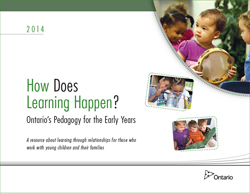
The Children’s Services Quality & Inclusion Support Services team helps support licensed child care centres in the implementation of HDLH? through site visits and professional learning opportunities. Click here for more information on HDLH?.
QUALITY CARE
Licensed child care settings in Ontario are regulated by the Child Care Early Years Act , 2014 (CCEYA) to help ensure safe, high‑quality environments for children and families. One of the best ways to determine whether a child care program is the right fit for your family is to visit the centre and observe the interactions between educators and children. Consider the relationships you see -are educators engaged and responsive? Is everyone in the program, including administration, educators, and support staff, approachable and open to questions? The Ministry of Education also provides a helpful list of questions to ask potential child care providers to ask potential child care providers, along with additional resources to support families in finding quality child care.
CHILDREN WITH EXCEPTIONAL NEEDS
Children’s Services administers Special Needs Resourcing to ensure that children with diverse needs can participate fully in early years and licensed child care programs at no additional cost to families. DNSSAB delivers these supports through the Quality and Inclusion Support Services (QISS) program to promote inclusive environments where all children can learn, grow, and engage alongside their peers.
Through QISS, Quality and Inclusion Program Specialists (QIPS) provide ongoing support to licensed child care and EarlyON programs across the District of Nipissing. This includes regular program visits, early identification and intervention supports, and individualized consultation. QIPSs work collaboratively with frontline educators to create inclusive environments that meet the unique needs of each child and ensure that families and educators are part of every step of the planning process.
Children’s Services also administers Enhanced Funding to help programs implement additional staffing supports for children who require a higher level of care.
In addition, EarlyON and licensed child care programs have access to professional learning opportunities designed to strengthen capacity in the areas of inclusion and special needs resourcing.
OTHER RESOURCES
Income Support
Ontario Works helps people who are in financial need by providing financial assistance to help with the costs of basic needs like food, clothing and shelter, as well as health benefits for clients and their families. Click here to learn more about the Ontario Works program and supports.
If you are struggling to pay your rent, heat or hydro, the Community Homelessness Prevention Initiative (CHPI) program may be able to help. Click here for more information about this program and other community services that may be of assistance.
Food Security
Food insecurity occurs when one does not have reliable access to a sufficient quantity of affordable, nutritious food. If you or someone you know requires support with food security, click on the links below to find more information on food banks and other services in your area to help with food security.